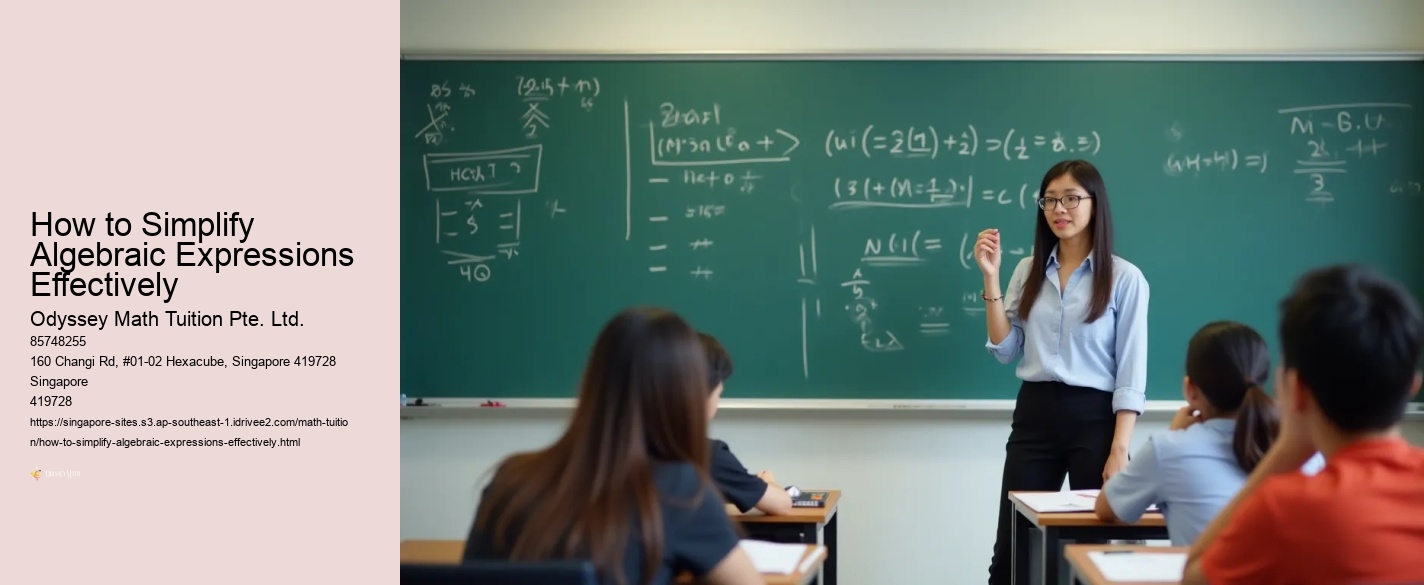
How to simplify algebraic expressions quickly: a Sec 4 guide
Understanding Algebraic Expressions
**HTML Fragment:**
Let's Simplify Algebraic Expressions: A Secondary 4 Math Guide
Fun Fact Alert! Did you know that the word 'algebra' comes from the Arabic word 'al-jabr', which means 'restoration' or 'rejoining'? It's from the title of a book written by Persian mathematician Muḥammad ibn Mūsā al-Khwārizmānī in the 9th century!
Understanding Algebraic Expressions: A Back-to-Basics Refresher
Algebraic expressions are like the building blocks of math. They're made up of numbers, variables (like x or y), and operations (+, -, *, /). For instance, 3x + 2y - 5 is an algebraic expression, where x and y are variables, and the numbers 3, 2, and 5 are coefficients.
Simplifying Expressions: The Key Steps
Combine like terms (e.g., 3x + 2x = 5x).
Rearrange the expression to follow the order of operations: PEMDAS (Parentheses, Exponents, Multiplication and Division from left to right, Addition and Subtraction from left to right).
Subtract like terms when combining (e.g., 3x - 2x = x).
In the Lion City's demanding post-primary schooling environment, the shift from primary to secondary presents learners to increasingly intricate mathematical concepts like fundamental algebra, integers, and geometric principles, that can be daunting lacking sufficient groundwork. A lot of guardians emphasize supplementary learning to close any gaps and foster a passion for the subject from the start. 1 to 1 maths tuition offers focused , Ministry of Education-compliant classes using qualified educators who focus on resolution methods, customized input, and engaging activities to build foundational skills. These courses often incorporate limited group sizes to enhance engagement and frequent checks for measuring improvement. Finally, putting resources in these foundational programs also improves scholastic results but also equips early teens with upper secondary demands and ongoing excellence within STEM disciplines..
Remember, the goal is to make the expression as simple as possible, with all like terms combined and in the correct order.
Secondary 4 Math Syllabus Singapore: What You Need to Know
In the Secondary 4 Math Syllabus by the Ministry of Education Singapore, you'll find that understanding and simplifying algebraic expressions is a key topic. As year five in primary brings about a heightened layer of intricacy in Singapore's mathematics syllabus, featuring ideas such as ratio calculations, percentages, angle studies, and complex verbal questions calling for keener reasoning abilities, families frequently look for approaches to ensure their children stay ahead while avoiding common traps of misunderstanding. This stage is critical since it immediately connects to PSLE preparation, in which built-up expertise is tested rigorously, making early intervention crucial in fostering resilience for addressing step-by-step queries. With the pressure building, dedicated help assists in converting possible setbacks into opportunities for advancement and mastery. h2 math tuition arms pupils with strategic tools and individualized mentoring matching Singapore MOE guidelines, using techniques such as model drawing, bar graphs, and timed drills to illuminate detailed subjects. In the city-state of Singapore's high-stakes post-primary schooling framework, pupils gearing up for O-Level exams often encounter intensified difficulties in mathematics, featuring advanced topics like trigonometric principles, fundamental calculus, and plane geometry, which demand strong comprehension plus practical usage. Parents frequently seek targeted assistance to ensure their teens can handle program expectations and foster test assurance with specific drills and strategies. math tuition offers vital reinforcement via Ministry of Education-matched programs, seasoned educators, and resources including previous exam papers and practice assessments to tackle individual weaknesses. The initiatives highlight problem-solving techniques effective scheduling, assisting students secure improved scores on O-Level tests. Finally, putting resources in such tuition not only equips learners for country-wide assessments but also establishes a strong base for further education in STEM fields.. Committed instructors emphasize conceptual clarity instead of memorization, fostering dynamic dialogues and error analysis to build self-assurance. At year's close, students generally show marked improvement for assessment preparedness, facilitating the route to a smooth shift onto Primary 6 plus more amid Singapore's rigorous schooling environment.. You'll learn to simplify expressions, solve equations, and even graph linear equations!
What If... You Could Simplify Expressions Like Magic?
Imagine being able to simplify expressions as easily as you tie your shoelaces. With practice and understanding, you can make that a reality! So, let's dive into some practice problems and turn you into an algebraic expression simplifying ninja!
Combining like Terms
**
Let's Get Started: The Math Adventure Awaits!
**
Imagine you're on a secret mission, armed with your trusty calculator and a pen that never runs out of ink. Your task? To simplify algebraic expressions, making them as neat and tidy as your bedroom when your mum's not looking! 😉
But first, let's understand what we're dealing with. Algebraic expressions are like secret codes, written in a language that only mathematicians - or secondary 4 students - can understand. They're made up of numbers, variables (like x, y, z), and operations (+, -, *, /).
**
Unlocking the Secrets: Understanding Algebraic Expressions
**
Variables are like mystery boxes. They can contain any number, and it's our job to find out what's inside!
Coefficients are the numbers that multiply the variables. They're like the sidekicks, helping the variables shine.
Constants are numbers that stand alone. They're like the supporting actors, adding depth to the equation's story.
**
Fun Fact: The Birth of Algebra
**
Algebra was born in ancient times, with the Babylonians and Egyptians using it to solve real-world problems. Imagine using math to predict floods or divide up land! 🌊🏠
**
Now, Let's Combine Like Terms: The Math Magic Trick!
**
Combining like terms is like finding your friends in a crowded mall. You look for the ones with the same clothes (variables) and the same hairstyle (coefficients). Then, you combine them into one big, happy group!
For example, in the expression 3x + 2y - 5, the like terms are 3x and 2y. Combining them gives us 5x + 2y - 5.
**
Interesting Fact: The Singapore Math Method
**
The Singapore math method, used in our very own secondary 4 math syllabus, is famous worldwide for its problem-solving and skill-building approach. It's like training your brain to be a math ninja! 🥷🧠
**
What If? The Challenge of Unlike Terms
**
But what if you can't combine terms because they're, well, unlike? Like trying to combine apples and oranges into one big fruit salad. You can't, right? 🍎🍊
In math terms, this means you can't combine terms with different variables or coefficients. But don't worry, you can still simplify the expression by rearranging the terms. For example, 3x + 2y can't be combined with 5z - 7, but you can rewrite it as 3x + 2y + 5z - 7.
**
The Future of Math: Where Do We Go From Here?
**
Algebra might seem scary now, but remember, every expert was once a beginner. In Singaporean pressure-filled academic landscape, year six in primary signifies the final phase for primary-level learning, during which pupils integrate accumulated knowledge in preparation for the all-important PSLE, dealing with escalated subjects like complex fractions, proofs in geometry, speed and rate problems, and comprehensive revision strategies. Guardians often notice that the jump in complexity could result in worry or comprehension lapses, notably with math, prompting the need for expert guidance to hone abilities and assessment methods. In this pivotal stage, in which all scores are crucial in securing secondary spots, extra initiatives become indispensable in specific support and confidence-building. h2 math online tuition provides in-depth , centered on PSLE sessions matching the latest MOE syllabus, featuring simulated examinations, error analysis classes, and customizable pedagogy for tackling personal requirements. Proficient instructors stress efficient timing and higher-order thinking, assisting students conquer the most difficult problems with ease. Overall, this specialized support not only improves results in the upcoming national exam while also imparts self-control and a enthusiasm for math extending to secondary levels and further.. With practice and patience, you'll be combining like terms like a pro in no time!
So, grab your calculator, sharpen your pencil, and let's dive into the exciting world of algebra together. Who knows? You might just become the next great mathematician Singapore has ever seen! 🌟📈
**
And That's a Wrap! 🎉
**
From understanding algebraic expressions to combining like terms, we've covered a lot of ground today. So, go ahead, give yourself a pat on the back. You've earned it!
And remember, math is like a language. The more you practice, the more fluent you become. So, keep exploring, keep learning, and most importantly, keep having fun!
In the city-state of Singapore's organized secondary education system, Secondary 2 learners begin tackling increasingly complex mathematical topics including quadratics, congruent figures, and statistical data handling, these expand upon Sec 1 foundations while readying ahead of advanced secondary needs. Families frequently seek additional resources to assist their teens adapt to such heightened difficulty while sustaining regular improvement amidst educational demands. Singapore maths tuition guide provides tailored , MOE-compliant sessions featuring experienced tutors who apply interactive tools, real-life examples, and concentrated practices to strengthen comprehension and exam techniques. Such sessions foster autonomous analytical skills while tackling unique difficulties such as algebra adjustments. Ultimately, this focused assistance improves overall performance, alleviates stress, and sets a solid path toward O-Level excellence and ongoing educational goals..
" width="100%" height="480">How to simplify algebraic expressions quickly: a Sec 4 guide
Using the Difference of Squares Identity
Recognise the pattern 'a² - b²' and simplify it to '(a - b)(a + b)'. This trick can save time when dealing with similar expressions.
Factorising Expressions
Identify common factors in terms to simplify them. Group like terms before factoring. Remember, a factorised expression is not unique.
Expanding Brackets
Use the distributive property to expand expressions inside brackets. Always check if there's an easier way to solve by examining the expression first.
Factoring Techniques
Identifying Common Factors
Before diving into factoring, it's crucial to spot common factors in expressions. These are numbers that divide both terms in the expression without leaving a remainder. For instance, in the expression 6x + 12, the common factor is 6. Spotting these is like finding a hidden treasure in algebra, making your work easier. Remember, secondary 4 math syllabus singapore emphasizes this skill.
Grouping Like Terms
Once you've identified common factors, group like terms together. These are terms that have the same variable(s) raised to the same power. For example, group 3x and 5x together, but keep 2y separate. It's like sorting laundry - you separate whites from colours, and singles from doubles. This step prepares your expression for factoring out the greatest common factor (GCF).
Factoring Out the GCF
Now, factor out the GCF from each group of like terms. The GCF is the largest number that divides all terms in the group without leaving a remainder. In the expression 6x + 12y, the GCF is 6. Factoring it out gives you 6(x + 2y). It's like finding the largest box that can fit all your items, making your expression neater and easier to handle.
Rewrite as a Product
After factoring out the GCF, rewrite the expression as a product. This means you'll have one factor with the GCF and another with the simplified terms in parentheses. The expression 6(x + 2y) is now in this form. It's like unpacking your box - you've sorted and organized everything inside it, making it easier to understand and use.
Verify Your Work
Lastly, check if your factored expression is correct by multiplying the factors back to the original expression. This is like checking if your unpacked box still contains all the items you packed. It helps you ensure that your factored expression is indeed simpler and equivalent to the original. As the city-state of Singapore's schooling structure puts a heavy focus on math competence from the outset, guardians have been progressively favoring organized support to help their youngsters handle the growing complexity in the syllabus during initial primary levels. As early as Primary 2, pupils meet more advanced subjects including addition with regrouping, basic fractions, and quantification, these expand on basic abilities and set the foundation for advanced problem-solving needed in upcoming tests. Recognizing the importance of ongoing support to stop early struggles and foster passion toward math, many turn to dedicated initiatives matching MOE guidelines. math tuition singapore delivers specific , dynamic classes designed to turn these concepts accessible and fun through hands-on activities, graphic supports, and customized feedback by qualified educators. In Singapore's secondary education scene, the transition from primary into secondary exposes students to increasingly conceptual math ideas such as basic algebra, geometry, and data management, that often prove challenging without proper guidance. A lot of families recognize that this bridging period requires extra bolstering to help teens adapt to the heightened demands and maintain solid scholastic results amid a high-competition setup. Expanding upon the basics set through PSLE readiness, targeted programs become crucial in handling individual challenges and encouraging autonomous problem-solving. JC 2 math tuition offers personalized classes matching Singapore MOE guidelines, integrating interactive tools, demonstrated problems, and practice challenges for making studies captivating and effective. Seasoned teachers prioritize bridging knowledge gaps from primary levels as they present secondary-specific strategies. Ultimately, this proactive help not only enhances grades and assessment competence while also cultivates a more profound appreciation for mathematics, readying students for achievement in O-Levels plus more.. This approach doesn't just aids kids overcome present academic obstacles and additionally cultivates analytical reasoning and perseverance. Over time, these initial efforts leads to smoother educational advancement, minimizing anxiety as students approach benchmarks such as PSLE and establishing a positive trajectory for lifelong learning.. This is an important step, especially when you're learning and practicing secondary 4 math syllabus singapore.
Rationalizing the Denominator
**
Simplifying Algebraic Expressions: A Secondary 4 Math Adventure
** **
Embarking on Our Journey: The Power of Algebraic Expressions
** Imagine you're in a magical forest, where trees are variables, and paths are operations. You're about to embark on an adventure where every step simplifies your path, much like solving algebraic expressions! Let's dive into the fascinating world of
** In our journey, we'll encounter fractions and irrational numbers. Don't be intimidated; they're just numbers who couldn't make it to the 'whole' party! Fractions are like friends sharing a pizza (they're equal parts), while irrational numbers are like that one friend who always brings extra toppings (they can't be expressed as simple fractions). **
Fun Fact!
** Did you know? The term 'irrational' was coined by the ancient Greeks, who thought these numbers were 'beyond reason' because they couldn't be expressed as simple fractions. Talk about a buzzkill at the math party! **
Simplifying Expressions: The Magic of Rationalizing Denominators
** Now, let's tackle what you've all been waiting for - simplifying expressions with fractions and irrational numbers. We'll use a technique called
rationalizing the denominator
, which makes our fractions behave like whole numbers. It's like giving them a 'whole' identity crisis! **
Step 1: Identify the Irrational Numbers
** Just like spotting a wild animal in the forest, you need to spot the irrational numbers in your expressions. They could be square roots (like √2) or decimals that never end or repeat (like π). **
Step 2: Multiply Both the Numerator and Denominator by the Same Number
** To rationalize the denominator, we'll multiply both the numerator and denominator by a special number. This number is the conjugate of the irrational number in the denominator. Think of it as giving our irrational friend a mirror image to help them blend in. **
Step 3: Simplify the Expression
** After multiplying, you'll notice that the irrational number in the denominator has disappeared, and you're left with a rational number. Ta-da! You've just rationalized the denominator. In the bustling city-state of Singapore's high-speed and scholastically intense environment, guardians recognize that establishing a strong learning base right from the beginning leads to a profound effect in a youngster's future success. The progression to the PSLE begins much earlier than the final assessment year, as foundational behaviors and skills in disciplines such as maths establish the foundation for advanced learning and analytical skills. Through beginning preparations in the initial primary years, learners may prevent typical mistakes, build confidence gradually, and cultivate a optimistic mindset towards challenging concepts which escalate later. math tuition centers in Singapore serves a crucial function within this foundational approach, offering age-appropriate, interactive classes that present basic concepts like simple numerals, geometric figures, and basic sequences matching the Singapore MOE program. The courses employ fun, engaging approaches to ignite curiosity and stop learning gaps from arising, promoting a seamless advancement across higher levels. Ultimately, putting resources in this initial tutoring not only reduces the burden associated with PSLE but also arms children for life-long reasoning abilities, giving them a competitive edge in Singapore's meritocratic system.. **
Interesting Fact!
** Rationalizing the denominator is like giving our irrational friends a 'rational' makeover. It's a technique that's been around since the 16th century, when mathematicians like François Viète and Simon Stevin developed it to simplify expressions. **
Algebraic Expressions in the Real World: A Quirky Anecdote
** You might think algebraic expressions are just math jargon, but they're everywhere! For instance, in cooking, a recipe like "1.5 cups of flour + 2 eggs - 1/4 cup of sugar" is an algebraic expression. Imagine if we couldn't simplify expressions; our cookies would be a disaster! **
What if...?
** What if you couldn't simplify algebraic expressions? You'd be stuck with a messy, complicated forest, struggling to find your way. But with rationalizing the denominator, you're like a skilled pathfinder, turning complexity into simplicity. **
So, Are You Ready to Be a Math Trailblazer?
** Embrace the power of algebraic expressions and equations. Simplify them, understand them, and watch as they unlock the secrets of the universe, one step at a time. As Singapore's math syllabus says, "With great learning comes great understanding." So, grab your math compass, and let's explore the wonderful world of mathematics together!
In the Republic of Singapore's rigorous schooling system, the Primary 3 level represents a significant shift where learners dive more deeply into subjects such as times tables, fraction concepts, and fundamental statistics, developing from previous basics to ready for sophisticated problem-solving. A lot of parents realize that classroom pacing on its own might not be enough for every child, motivating their search for supplementary help to foster math enthusiasm and avoid early misconceptions from forming. At this juncture, customized learning aid proves essential for maintaining educational drive and encouraging a development-oriented outlook. best maths tuition centre provides concentrated, syllabus-matched guidance through group sessions in small sizes or one-on-one mentoring, emphasizing creative strategies and graphic supports to simplify challenging concepts. Tutors frequently incorporate playful components and ongoing evaluations to track progress and increase engagement. Finally, this proactive step not only improves current results while also establishes a solid foundation for thriving in higher primary levels and the upcoming PSLE..
Applications in Real-life Situations
**
**
Unlocking the Magic of Algebra: A Secondary 4 Math Journey
Imagine you're at a bustling hawkers' centre, like the famous Tiong Bahru Market. You spot your favourite char kway teow stall, but the queue is crazy long! How long will you wait? To find out, you'll need to understand algebra - yes, that's right! It's not just for solving textbook problems; it's everywhere, even in your favourite Singapore hawker centre.
Algebraic Expressions: The Secret Language of Math
Algebraic expressions are like the secret language of math, using variables (like x or y) to represent unknown values. In Singaporean, the schooling structure concludes primary-level education through a nationwide test designed to measure learners' scholastic performance and determines future secondary education options. The test is administered every year among pupils during their last year in primary school, focusing on core disciplines for assessing comprehensive skills. The Junior College math tuition acts as a reference point for assignment to suitable secondary programs depending on scores. It includes subjects including English Language, Mathematics, Science, and Mother Tongue Languages, featuring structures updated periodically to match academic guidelines. Grading relies on performance levels spanning 1 through 8, where the overall PSLE result equals the addition of individual subject scores, impacting upcoming learning paths.. In the Republic of Singapore's merit-driven schooling framework, the Primary 4 stage functions as a key milestone in which the curriculum becomes more demanding including concepts like decimal operations, symmetrical shapes, and basic algebra, challenging pupils to apply logic via systematic approaches. Many households realize that school lessons alone could fail to adequately handle unique student rhythms, leading to the pursuit for supplementary tools to solidify topics and ignite lasting engagement with maths. With planning ahead of PSLE increases, steady practice proves vital for conquering those core components without overwhelming young minds. Singapore exams provides tailored , engaging instruction that follows MOE standards, incorporating real-life examples, puzzles, and tech aids to transform theoretical concepts tangible and fun. Seasoned instructors prioritize detecting weaknesses promptly and turning them into strengths with incremental support. In the long run, this dedication cultivates perseverance, improved scores, and a smooth progression to advanced primary levels, preparing learners for a journey to academic excellence.. In our hawker centre scenario, x could represent the number of people ahead of you in the queue. The expression x + 1 would then represent your position in the queue - you're always one step behind the person in front of you.
Fun Fact: Did you know that the word 'algebra' comes from the Arabic word 'al-jabr'? It means 'restoration' or 'rejoining', referring to the process of moving terms from one side of an equation to the other.
Simplifying Expressions: The Quickest Way to Your Char Kway Teow
Simplifying algebraic expressions helps us solve problems faster. Let's say the queue moves at a rate of 2 people per minute. If you're x + 1 in the queue, you'll wait for (x + 1) ÷ 2 minutes. Simplifying this expression gives us:
x/2 + 1/2
This means you'll wait x/2 minutes for the queue to halve, plus an extra 30 seconds (which is 1/2 minute).
Equations: Solving Mysteries One Step at a Time
Equations are like mathematical mysteries. They help us find the value of variables. If you know the total waiting time, you can find out how many people are ahead of you. For example, if it takes you 6.5 minutes to reach the front, you can set up the equation:
x/2 + 1/2 = 6.5
Solving this equation, you'll find that x = 12. So, there were 12 people ahead of you - not so bad, eh?
Interesting Fact: The concept of equations was first developed by the ancient Babylonians around 2000 BCE. They used clay tablets to record their mathematical findings.
Algebra in the Secondary 4 Math Syllabus
Understanding algebraic expressions and equations is a key part of the Secondary 4 Math Syllabus in Singapore. According to the Ministry of Education, students should be able to manipulate and solve simple linear equations in one variable. So, the next time you're waiting in line, you'll know you're not just waiting - you're practicing your algebra!
What if you could use your algebra skills to predict the perfect time to visit your favourite hawker centre? With a bit of practice, you just might.
So, grab your calculator and your appetite, and let's CAN Makan! (That's Singlish for "let's eat!")
How do I combine like terms in an algebraic expression?
To combine like terms, you add or subtract the coefficients (numbers) in front of the same variables. For example, 3x + 2x = 5x.
What is the difference between a monomial, binomial, and polynomial?
A monomial is an expression with one term, a binomial has two terms, and a polynomial is an expression with three or more terms.
How do I factor out the greatest common factor (GCF)?
To factor out the GCF, identify the common factor in each term, then write it in front of the expression in parentheses, followed by the variables with the lowest exponent.
What is the distributive property and how is it used in simplifying expressions?
The distributive property allows you to multiply one number by each term inside a parenthesis. Its used to simplify expressions by breaking down multiplication into repeated addition.
How do I simplify square roots in algebraic expressions?
To simplify square roots, first determine if the expression under the root is a perfect square. If it is, you can rewrite the expression with the square root of the perfect square.
How do I solve one-step and multi-step equations involving algebraic expressions?
One-step equations can be solved by performing the inverse operation of the given operation. For multi-step equations, follow the same principle, but perform the operations in reverse order, making sure to isolate the variable on one side of the equation.